
Embodied Carbon for Interior Material Decisions
A designer-focused workflow for comparing interior materials with EPD data, visual studies, samples, and a clear specification record.

Interior material selection is becoming a data task as well as a visual one. Color, texture, durability, cost, and lead time still matter, but a designer may now be asked to compare the climate impact of wallboard, flooring, insulation, timber products, ceilings, metals, paints, and furniture.
The change is visible in current standards. Commercial interior projects pursuing the LEED v5 Interior Design and Construction rating system must quantify cradle-to-gate embodied carbon for defined interior material scopes and identify the top three sources. That moves carbon work out of the sustainability appendix and into everyday specification decisions.
Separate the visual question from the carbon question
A render can show whether a cork floor, wool acoustic panel, or reused timber wall fits the design direction. It cannot prove the product's global warming potential, service life, source, chemical content, or availability.
Run two tracks in parallel:
| Visual track | Evidence track |
|---|---|
| Does the material support the concept? | Is there a current, relevant declaration? |
| How does it behave under project lighting? | What life-cycle stages and units are reported? |
| Where should it appear in the room? | Are the products being compared on the same basis? |
| What adjacent finishes make it work? | Does durability or replacement change the decision? |
The tracks meet at specification. Neither replaces the other.
Start with quantity and frequency
Do not spend the first research hour comparing two tiny cabinet pulls. Begin with products used across large areas, repeated through the project, replaced frequently, or associated with a known high impact.
For a typical interior scope, that may bring attention to:
- floor finishes and adhesives
- ceiling systems and acoustic products
- gypsum board, framing, and insulation
- millwork and composite wood
- paint and wall coverings
- metal features and partitions
- loose furniture when it is part of the project brief
The AIA Materials Pledge recommends a wider lens than carbon alone, including human health, social equity, ecosystem health, and circularity. That matters because the lowest number in one column is not automatically the best product for the room.
Build a comparable product shortlist
An Environmental Product Declaration, or EPD, reports environmental impacts using a defined method. It is evidence, not a sustainability badge. Before comparing two values, check that the products serve the same function and that the declarations use compatible units, product category rules, system boundaries, and reporting periods.
Use a simple comparison sheet:
| Field | Product A | Product B | Open question |
|---|---|---|---|
| Intended use | Same performance need? | ||
| Functional unit | Directly comparable? | ||
| A1 to A3 global warming potential | Same life-cycle scope? | ||
| Expected service life | Replacement likely? | ||
| Installation system | Adhesive or subframe impact? | ||
| Local availability | Transport and lead time? | ||
| End-of-life route | Reuse, take-back, recycling? | ||
| Other health or project criteria | Any disqualifying concern? |
When declarations are not comparable, record the gap. Do not convert an uncertain comparison into a false ranking.
Use visual studies to reduce specification churn
Carbon research is wasted if the shortlisted product is rejected late because no one tested its effect on the scheme. Before requesting final samples, create a controlled visual comparison.
Keep the camera, layout, lighting, and surrounding finishes fixed. Change only the material family under review. The material and color visualization workflow explains how to keep that test narrow. A useful set might compare:
- retained existing floor, repaired and refinished
- new resilient floor with verified product data
- modular finish designed for selective replacement
The image should be labeled as a visual study. Once a direction survives that test, inspect the physical sample under project-relevant light and confirm technical performance with the manufacturer and specification team.
Put reuse before product substitution
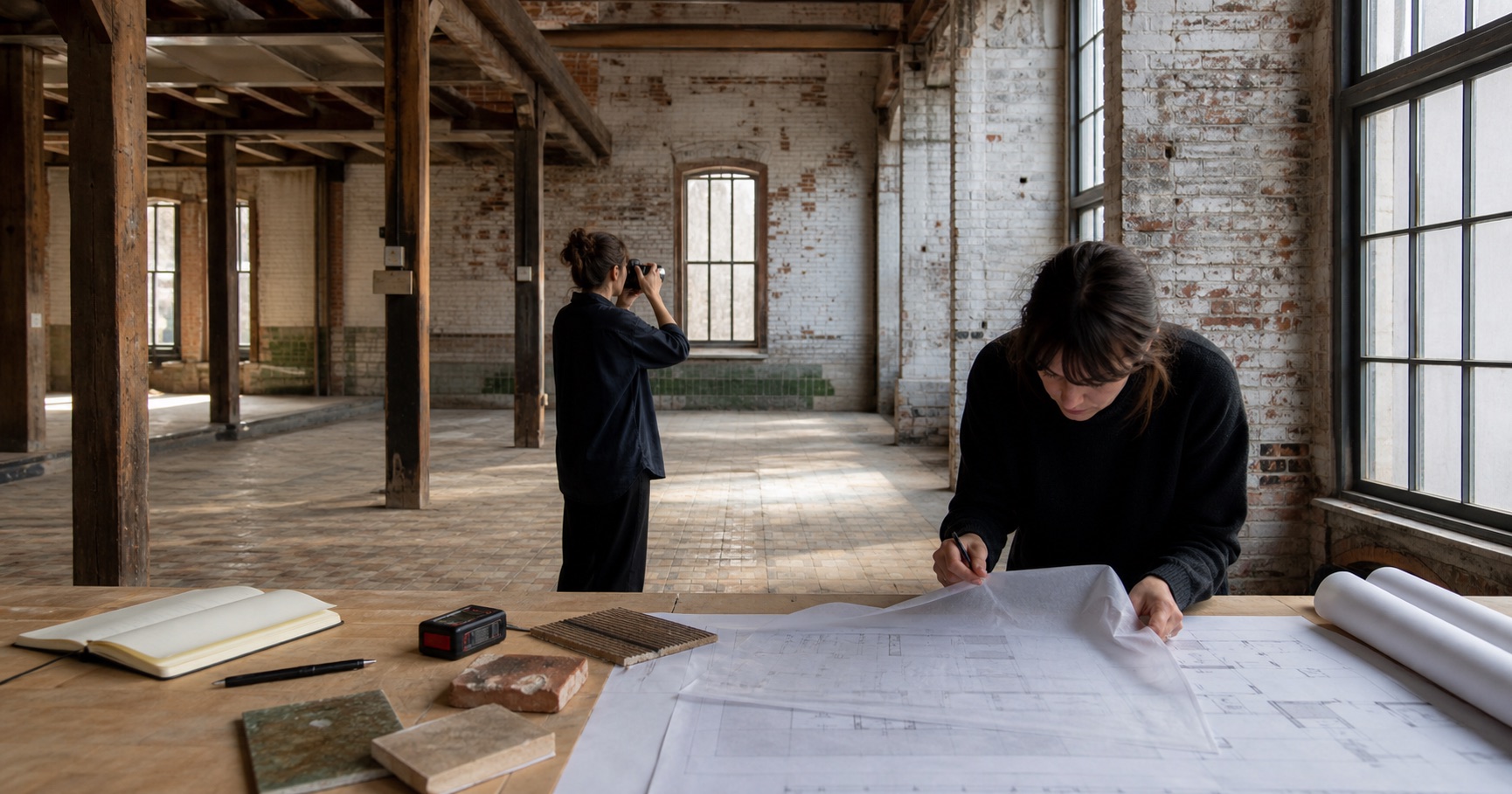
The most persuasive low-carbon material may be the one already installed. Retaining a sound floor, exposing an existing soffit, reusing doors, or adapting millwork can avoid new material while preserving useful character.
The AIA Framework for Design Excellence puts building reuse, space efficiency, longevity, and adaptability ahead of product optimization as early resource strategies. For an interior designer, that changes the first question from "Which new finish has the lowest number?" to "What can remain, and what work would make it acceptable?"
This also connects material research to the adaptive reuse design workflow. Existing conditions must be surveyed and tested before the team can count retention as a real design decision.
Record the decision at the point of selection
A material board shows appearance. A specification shows requirements. The carbon record should connect the two.
For each selected high-priority product, capture:
- manufacturer, product, and finish
- area, volume, mass, or project quantity used for calculation
- declaration title, identifier, and validity date
- reported unit and life-cycle stages
- comparison basis and rejected alternative
- maintenance and replacement assumption
- person responsible for final verification
If the preferred product changes during value engineering, reopen the comparison. "Or equal" is not equal when the evidence, durability, or installation system changes.
Give the client a decision they can understand
Avoid opening a client presentation with a dense life-cycle spreadsheet. Lead with the design consequence:
We can retain and repair the existing timber floor in the reception area. This preserves the project's character, avoids a new finish across a large area, and reduces demolition. The repair mockup and cost check are the next approvals.
Then show the supporting data at the level the client needs. If a new product is required, explain what was compared, what is known, and what remains uncertain.
The AI Interior Design workspace can help a team visualize retained and alternative finishes before committing to sample rounds. It cannot validate an EPD or calculate the project quantity. Keep the visual output attached to the research sheet so that appearance and evidence do not drift apart.
A practical material decision sequence
- Confirm the room function and performance brief.
- Identify high-quantity, high-frequency, and high-impact material scopes.
- Ask what can be retained, repaired, or reused.
- Build a small shortlist with comparable declarations.
- Visualize only the options that pass the evidence screen.
- Review physical samples, installation, maintenance, cost, and availability.
- Record the selected product and the basis for comparison.
- Recheck the decision if procurement proposes a substitution.
Embodied carbon does not need to turn every designer into a life-cycle analyst. It does require a cleaner handoff between concept, evidence, specification, and procurement. That handoff is where a good material intention becomes a project result.
From reading to reimagining
Explore these ideas in your own space
Find a tool for the next step in your project.